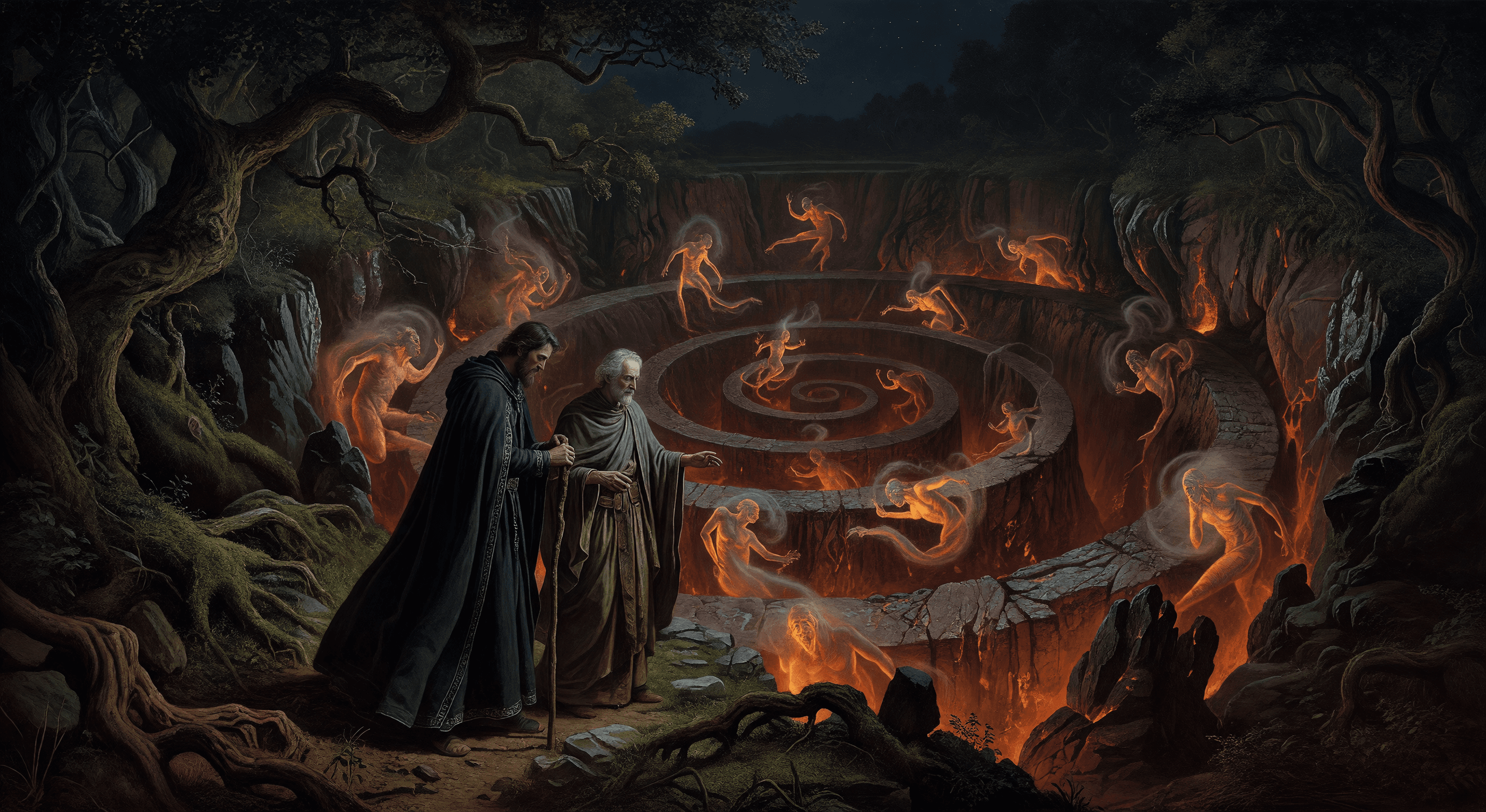
The Divine Comedy of Dante Alighieri: The Inferno
Dante Alighieri
Public domain worldwide
52 chapters · 1,003 paragraphs
Set in medieval Christian cosmology, the Inferno represents Hell as a detailed, structured underworld reflecting 14th-century Italian Catholic theology. The visual tone is consistently dark, Gothic, and allegorical, combining classical references with medieval Christian imagery, emphasizing spiritual punishment and moral consequence.
Characters
Dante Alighieri
A medieval Italian poet in his early thirties, wearing long robes typical of 14th-century Florence. He has a serious, contemplative expression and often appears troubled or in spiritual distress as he journeys through the underworld.
Virgil
An elderly Roman poet with dignified bearing, dressed in classical Roman garments. He appears wise and authoritative, with gray hair and a composed demeanor, serving as Dante's guide and mentor.
Charon
A demonic ferryman of grotesque appearance with a muscular, skeletal frame. He typically wears ragged clothing and carries an oar, with a fierce, intimidating expression befitting an infernal guardian.
Minos
A monstrous judge with a serpentine or bull-like appearance, depicted as a towering figure of authority and dread. He wraps his tail around himself to indicate the circle of Hell to which souls are damned.
Settings
The Dark Wood (Selva Oscura)
A dense, shadowy forest at night with gnarled trees and an oppressive atmosphere. Darkness dominates, with only faint light filtering through twisted branches, conveying despair and spiritual confusion.
Hell (Inferno)
A vast subterranean landscape of concentric circles descending into Earth, featuring rocky cliffs, fiery pits, frozen lakes, and dark caverns. The visual tone is Gothic and nightmarish, with flames, shadows, and tormented souls in various landscapes of punishment.
The River Acheron
A dark, turbulent river at the edge of Hell with murky waters and a gloomy shoreline. The atmosphere is ominous and foreboding, with souls gathering at its banks awaiting passage into the underworld.
The City of Dis
A fortified infernal city with towering walls, iron gates, and red flames emanating from within. The architecture is medieval yet demonic, with a distinctly Gothic and menacing character.
Contents
- The Project Gutenberg eBook of The Divine Comedy of Dante Alighieri: The Inferno
- THE DIVINE COMEDY OF DANTE ALIGHIERI
- BY JAMES ROMANES SIBBALD
- THE INFERNO
- PREFACE.
- FLORENCE AND DANTE.
- II.
- III.
- IV.
- V.
- VI.
- FOOTNOTES:
- GIOTTO’S PORTRAIT OF DANTE.[142]
- FOOTNOTES:
- FOOTNOTES:
- FOOTNOTES:
- FOOTNOTES:
- FOOTNOTES:
- FOOTNOTES:
- FOOTNOTES:
- FOOTNOTES:
- FOOTNOTES:
- FOOTNOTES:
- FOOTNOTES:
- FOOTNOTES:
- FOOTNOTES:
- FOOTNOTES:
- FOOTNOTES:
- FOOTNOTES:
- FOOTNOTES:
- FOOTNOTES:
- FOOTNOTES:
- FOOTNOTES:
- FOOTNOTES:
- FOOTNOTES:
- FOOTNOTES:
- FOOTNOTES:
- FOOTNOTES:
- FOOTNOTES:
- FOOTNOTES:
- FOOTNOTES:
- FOOTNOTES:
- FOOTNOTES:
- FOOTNOTES:
- FOOTNOTES:
- FOOTNOTES:
- NOTE ON THE COUNT UGOLINO.
- FOOTNOTES:
- FOOTNOTES:
- INDEX OF PROPER NAMES AND PRINCIPAL SUBJECTS OF THE INFERNO.
- Chapter 51
- Chapter 52